Thursday, February 26, 2015

Puffed Up Bird Contest

Apparently, there was a puffy bird contest today that I did not know about.  Who can get the fattest looking?   Here are the top three contenders.   Which would you pick as the winner?

1.  Mourning Dove

2.  Eastern Bluebird

3.  American Robin

I gave first prize to the robin.  It seemed the biggest to me, even from the back.


This robin was stubbornly guarding the mealworm tray.  He perched on the hook as if to say, "If I have to stay here all day to protect my mealworms, I will.   I can nap right here next to the feeder."

(Now that's a problem!  I prefer bluebirds to visit more than any fat robin!)


Other visitors of the not-quite-so-puffy variety:

Downy Woodpecker

Northern Flicker

 American Goldfinch

Dark-Eyed Junco (female)

 Dark-Eyed Junco (male)

 Tufted Titmouse

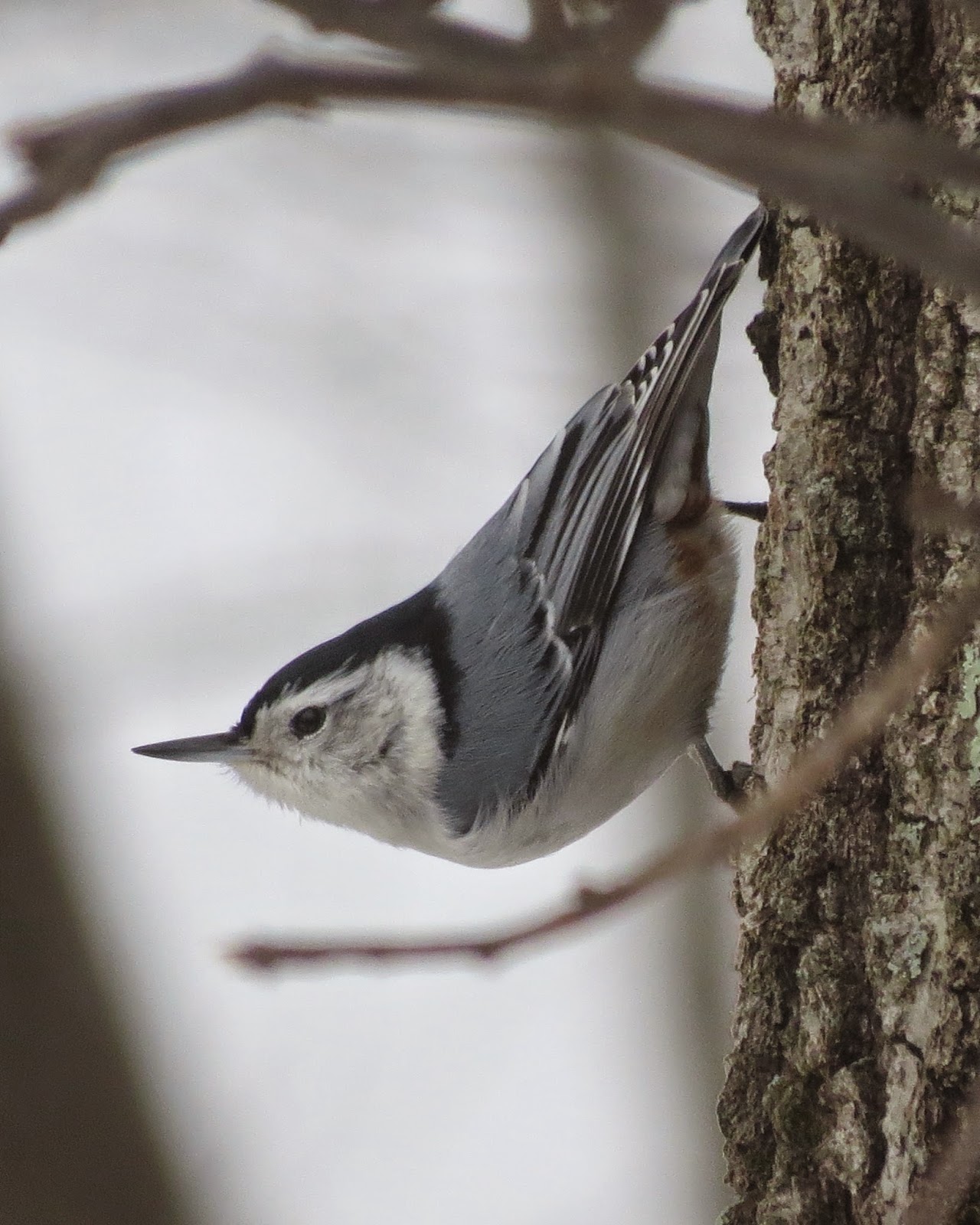
White-Breasted Nuthatch

And yes, those are snowflakes in some of the pictures.  Don't even ask.  This was the week they said we would not have any storms.  So I guess flurries don't count?


Wednesday, February 25, 2015

White-Tailed Deer

I was up and out of the house earlier than usual today to drop my car off for maintenance.  On my way out the driveway, I spotted a White-Tailed Deer curled up in a circle and sleeping in a low spot in the deep snow in the wetlands.  I hoped it might still be there when I returned (no luck).  Now I hope that it is a regularly sleeping spot and that I might find it there again tomorrow.

A little later in the morning, two White-Tailed Deer pushed through the snow, one making its way directly to my sunflower seed feeder (and the rather large amount I spilled when I dropped it while filling it yesterday).  A second deer stayed in the woods and was nibbling at the smaller trees.

To be fair, when I went out the other day to fill my birdfeeder, there were plenty of clues that deer were in the area and liked the seed.  Tracks were all over the path my hubby had snow-blowed out to my feeder.  Scat was all over it, too.

The poor deer are expending much more energy just to make their way through this amount of snow (when they are not on cleared paths!), and it's also making food harder to find.  I wonder how hard it is to stay warm when they are leg-deep in the white stuff most of the day.


Oh, those eyes!


 Yum!


This serious look was the result of the first deer hearing a second deer trudging through the deep snow in the woods.  She was relieved when it kept going and didn't make her share her treasure trove of sunflower seeds.


During my lunch break, on the way to pick up my car, three deer were together in that same low spot in the wetlands.  Apparently, being in a sheltered area, near food and water, is a good thing.  By the time I got my camera, and returned to the scene, they were no longer lying on the ground.


Beside the deer, I also saw a couple species of birds drinking the melting snow from my shed roof.  We have a stream running across our property, and I've always felt that should be a sufficient enough natural water supply so I have never put out a birdbath.  I find it interesting that they drink from the shed roof drippings.  Maybe it's more conveniently located to the seed supply?  Maybe it's safer than having to land on the ground and drink from a stream?

My photos are poor, through the window and long distance, but it documents what I find to be an interesting behavior.  Around this time last year, I had the same sighting.  Check it out here.


The above bluebird flew in so fast and furious that it slid across the tray, clearing all the mealworms off as it went.  It still managed to grab one in the process.

 Eastern Bluebird (male)

Northern Cardinal (male)

The backyard bird star of the day was the Tufted Titmouse.  This little bird sat for a long time on the hook, and its crest went up and down, almost as if in time with a slow yogic breath.  It was a very cooperative model!

 Tufted Titmouse


Beautiful Banyan Trees

I didn't know much about Banyan Trees, besides the fact that they are really impressive looking and I couldn't resist photographing them!  Here's what I learned with a little online research:

Banyan trees are native to India, Pakistan and Sri Lanka.  They are sacred to both Hindus and Buddhists.  They are often planted around temples in those countries and are commonly used in city parks and botanic gardens in Florida and other tropical areas.

It is a FIG tree and a member of the mulberry family.  The other fascinating thing about it is that it starts out as an epiphyte.  What is an epiphyte, you say?  Wikipedia provides the following definition:

      An epiphyte is a plant that grows non-parasitically upon another plant (such as a tree), 
      and derives its moisture and nutrients from the air, rain, and sometimes from debris 
      accumulating around it instead of the structure it is fastened to.

So, a bird eats a fig from a banyan tree, flies into a palm tree (for example) and poops out a tree seed on the tree top.  An epiphyte is born and as it grows, it sends roots DOWN from horizontal branches which eventually take root when they touch the ground.  Eventually, I would assume that the banyan tree strangles out the palm tree and takes over completely.

Banyan trees can grow up to 100 feet tall and spread over an area of several acres.  There is a famous tree in Poona, India which is said to measure 1/2 mile around and is able to shelter 2000 people.  Whoa.  Also a fun fact:  In India, the edible leaves are used as plates!

At the Thomas Edison winter estate in Fort Myers, Florida, there is also a famous banyan tree.  He originally planted it there because he, Henry Ford,  and Harvey Firestone, hoped to use its sap to create natural rubber.  Their idea didn't pan out, but the tree remains.  We visited the estate in 2007.  It's a great stop and has a wonderful museum.

Thomas Edison Winter Estate banyan tree (Fort Myers, FL)


Naples, FL  

 Seagate Dr, Naples, FL

 ditto

Naples, FL zoo

Tuesday, February 24, 2015

Backyard Birds

I was so happy to see Eastern Bluebirds in my yard again since my trip to Florida.  My brother had teased me that they would die without me here to feed them, but luckily, the neighbor behind us also feeds the birds, so they are still surviving this miserable winter!

 Eastern Bluebird (female)
just look at those feathers all puffed up for warmth

Today, I had my first American Robin come to the mealworm feeder.  It was certainly puffed up against the cold temperature.


I heard that Northern Cardinals are brighter in winter than in summer.  This one certainly seems it!  According to Birds of North America Online, brighter males have higher reproductive success, hold better territories and offer more parental care.  The intensity of the color is related to the food eaten.  Female attraction to more colorful feathers as a sign of a good mate selection has encouraged the evolution of bright colors.  Since February and March are peak breeding season for cardinals, now is the time for all good males to don their bright red feathers.

Northern Cardinal
 frequent visitor to the sunflower seed feeder

 Eastern Bluebird (male)

 Eastern Bluebird (female)

These two were sheltering as close to the large tree trunk as possible to get out of the wind.  It stretched the limits of my zoom lens to catch them, but they were so cute side-by-side and looking in the same direction!

Dark-Eyed Junco (aka Snowbird)
also visiting the mealworm feeder


Monday, February 23, 2015

The Anhinga

This fascinating bird deserves a post all its own.  In many ways, it looks like our local cormorants.  Its bill is pointed like a dagger, its neck is snakier and its tail is longer.   Average wingspan is 3 feet 9 inches.  They can swim low in the water, with only their neck and head showing, giving them the nickname "snake-bird".

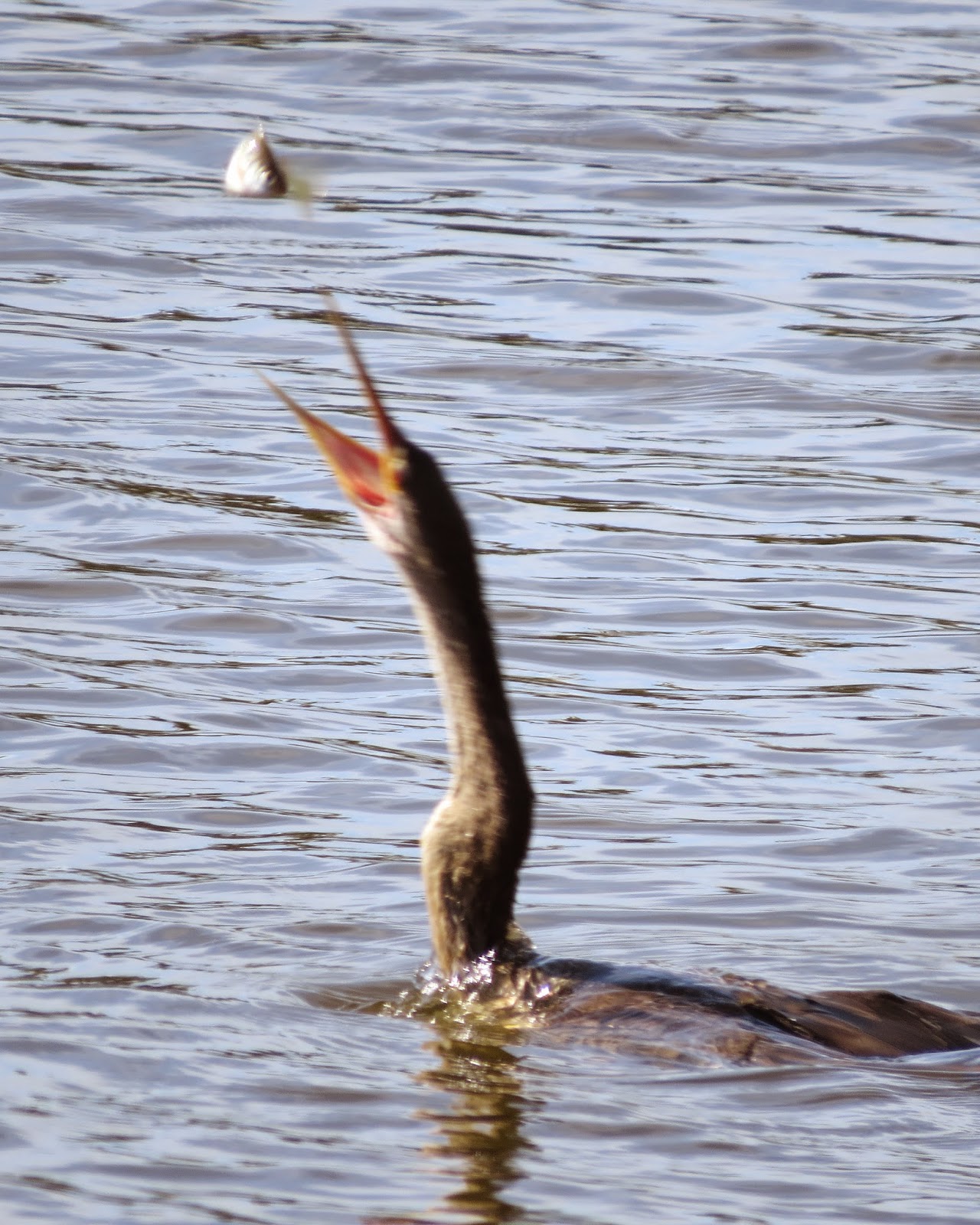
Now for the interesting stuff.  Anhingas' feathers become saturated faster than other waterbirds.  This is what enables them to swim the way they do, with their body under water and head/neck above.  Anhingas can submerge without diving by regulating their buoyancy.  While swimming under water, they only use their feet and not their wings to propel through the water.  A special adaptation in its neck allows it to retract it into an S-shape and then thrust it forward like a spear.  Anhingas may spread their wings underwater to lure fish into the shade they create, known as "canopy feeding".  After spearing prey, an Anhinga surfaces, tosses its prey into the air and then catches it head-first for ease in swallowing.  The inside of their bill is lined with barbs pointing inward, which helps them hold onto a slippery fish.

I assumed that the Anhinga didn't have oil in its feathers and that was why it had to air dry them after swimming.  That is not the case.  The Anhinga's feathers have tiny spaces in them where the water can collect.  As a result, they lose buoyancy and are able to swim under water.  Anhingas have no insulating feathers next to their body, so part of their reason for spreading their wings in the sun is to dry, but they are also there to warm up.

Males are black with silver wing feathers and females have a buff colored neck and head.

I was able to photograph some of their behaviors, although not all of the photos are crisp.  Still, I am glad for the chance to have seen it.  I knew nothing about this bird, so it was all surprising to witness.  Fun!


Speared


Speared

Note prey head is away from Anhinga

Now it tosses it and turns it around in one motion!